According to CCTV News, the National Development and Reform Commission reported that this year has seen further strengthening of China's computing infrastructure. The nation's first all-domestic 10-thousand-card AI supercluster has officially launched, marking a new phase in China's computing infrastructure development with deployments reaching 10 thousand-card scale.
Massive cluster expansion: computing nodes scaling up rapidly
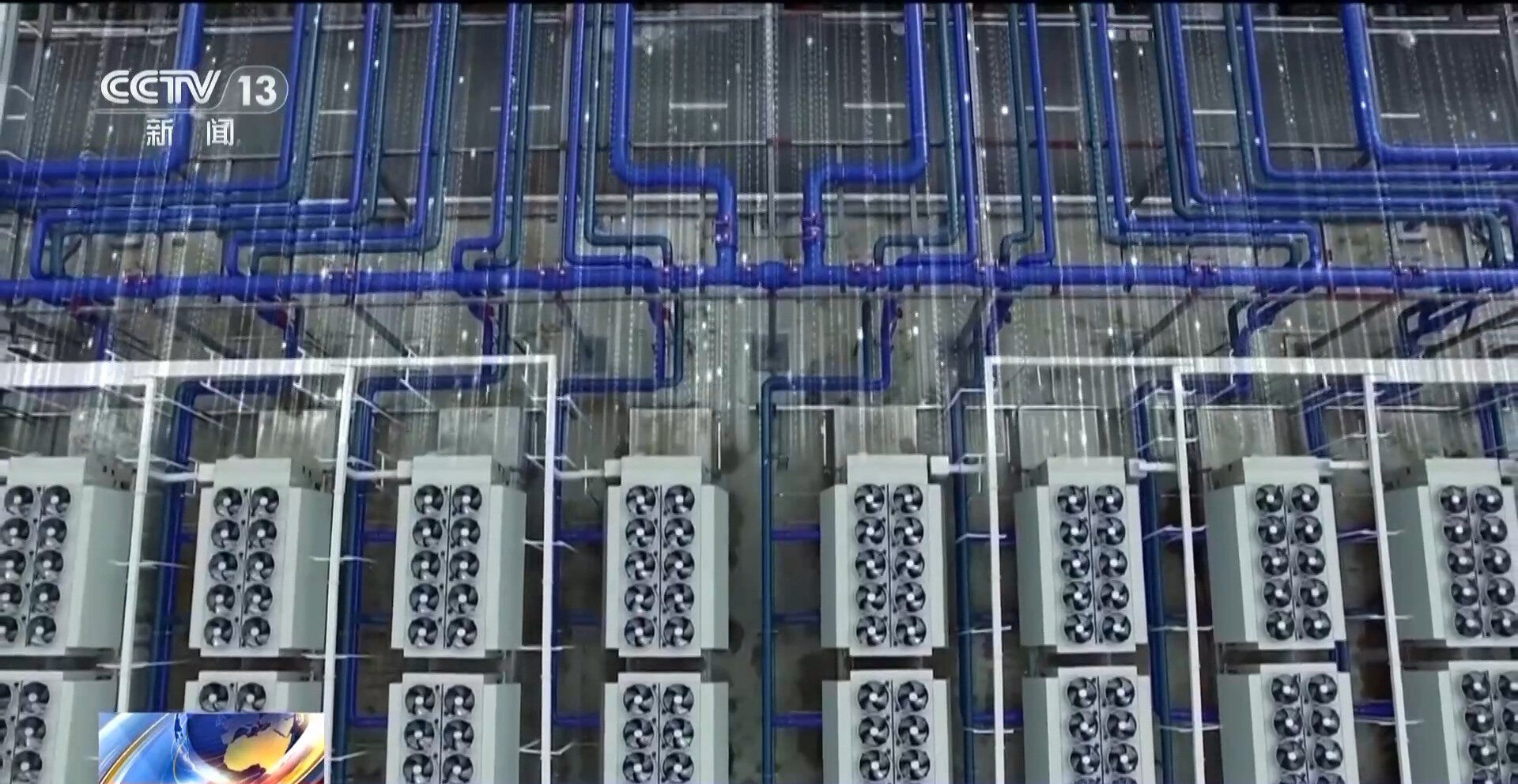
Multiple computing nodes across the nation are undergoing a new round of capacity expansion. At the National Supercomputing Internet's Zhengzhou Core Node, China's first all-indigenous 10 GPU AI supercluster has gone live. Staff told reporters that what sets this facility apart is its fusion of scientific and intelligent computing, positioning it for future emerging computing demands.
Bu Jingde, Chief Engineer of High-End Computing at the National Supercomputing CenterThis new computing cluster delivers peak performance equivalent to the entire human race computing continuously for 200 years. It currently supports over 300 types of computational tasks across 26 domains, including new materials, innovative drugs, and artificial intelligence.
At the Guangdong-Hong Kong-Macao Greater Bay Area national hub node of the "East Data, West Computing" project, a new domestic ultra-node 10,000-card cluster has been launched to directly meet the intelligent computing power demands for next-generation large model development.
Liu Zhijun, Head of Planning and Construction for the Integrated Data Center in the Guangdong-Hong Kong-Macao Greater Bay Area, China Telecom:Domestic large models are evolving from hundreds of billions to trillions of parameters. Our newly launched intelligent computing cluster reduces training time for trillion-parameter models from one year to approximately six months, while providing a full-stack verification and testing environment.
The "Shenzhen-Guizhou" high-speed channel for computing resource scheduling is accelerating its implementation.
Expanding computing capacity continues to drive growth in China's overall computing network. How can we better interconnect computing resources? According to the latest updates from Pengcheng Laboratory, a national-level computing resource scheduling backbone is accelerating its deployment.
By the end of 6, China's intelligent computing capacity grew 177% year-over-year, reaching 2185 exaflops per second.
To address uneven distribution of computing resources and accelerate the construction of a national integrated computing network, efforts are underway to unify monitoring and scheduling of computing power. At Peng Cheng Laboratory, researchers are actively developing next-generation optical fibers for this purpose.
Li Chao, Associate Research Fellow at Pengcheng Laboratory:This fiber is as thin as a human hair. Under a microscope magnified 60 times, you can see it contains 4 channels—equivalent to running 4 high-speed rail lines simultaneously—boosting transmission capacity by over 4 times and breaking through the limits of conventional fiber optics.
Next, the research team will deploy next-generation fiber and equipment to establish "Shenzhen-Guizhou Line," a national ultra-high-bandwidth, 1,000-kilometer computing dispatch corridor with low latency and direct optical connectivity. This initiative will accelerate the flow of computing resources between computing hubs and AI application clusters in Shenzhen and Guizhou.
Creates investment opportunities for private capital in areas such as integrated calculation and power systems.
Fragmented computing resources will be rapidly consolidated, boosting the utilization rate of national computing infrastructure. The national integrated computing network is taking shape faster, unlocking a trillion-dollar investment opportunity.
Centered on the eight national hubs of the "East Data, West Computing" initiative, a millisecond-level computing service network now spans major regions across eastern and western China. A new nationwide integrated computing network monitoring, scheduling, and pilot verification platform has entered trial operation. Over 60% of national computing capacity is now under unified monitoring, with continuous improvements in computing resource access and precise matching capabilities. These services support over 100 application scenarios, including artificial intelligence, industrial manufacturing, and scientific research. The vision of a unified national computing system—a single "chessboard" and "network"—is steadily taking shape.
Guo Mingjun, Director of the Computing Power Economy Division, National Information Center, National Development and Reform Commission:During the 15th Five-Year Plan period, direct investment in computing power network construction is projected to reach 4 trillion yuan, primarily driven by private sector investment. Focusing on key areas such as computing power monitoring and scheduling, coordinated computation and energy management, and ultra-large-scale AI clusters, this initiative will create substantial investment opportunities for diverse market entities, continuously empowering digital and intelligent transformation across industries, and supporting high-quality development of China's digital economy.